
Custom Sapphire Manufacturing: From Design to Finished Component
Custom Sapphire Manufacturing: From Design to Finished Component
The Custom Sapphire Manufacturing Process
Custom sapphire optics require a multi-stage manufacturing process that demands specialized equipment and extensive process knowledge at each step.
Stage 1: Crystal Preparation
- Synthetic sapphire boules (grown by Kyropoulos or HEM methods) are cut to near-net-shape using diamond sawing
- Cut orientation is critical—sapphire's optical properties vary with crystal axis orientation
- Surface flatness of cut blanks must be controlled to minimize subsequent machining stock removal
Stage 2: CNC Machining and Grinding
- CNC grinding with diamond abrasive wheels reduces geometry to near-final dimensions
- Standard tolerances are ±25μm for most geometries; tighter tolerances (±10μm or better) require extended process development
- Complex geometries (undercuts, tapered walls, non-rotational profiles) require 4-axis or 5-axis CNC machining
Stage 3: Precision Polishing
- Multi-stage polishing with progressively finer abrasives achieves final surface quality
- For optical surfaces, final polishing reaches Ra < 0.1nm surface roughness
- Domed and spherical surfaces require specialized polishing fixtures and process development
Stage 4: Coating (if applicable)
- Anti-reflective (AR) coatings applied by physical vapor deposition (PVD)
- Diamond-like carbon (DLC) coatings for enhanced scratch resistance
- Multi-layer broadband coatings for multi-spectral applications
Stage 5: Quality Verification
- Interferometric surface measurement for surface accuracy (waves RMS)
- Spectrophotometric transmission measurement across required wavelength range
- Dimensional measurement using coordinate measuring machines (CMM) or optical comparators
Customization Options for Sapphire Optical Components
Geometry Customization
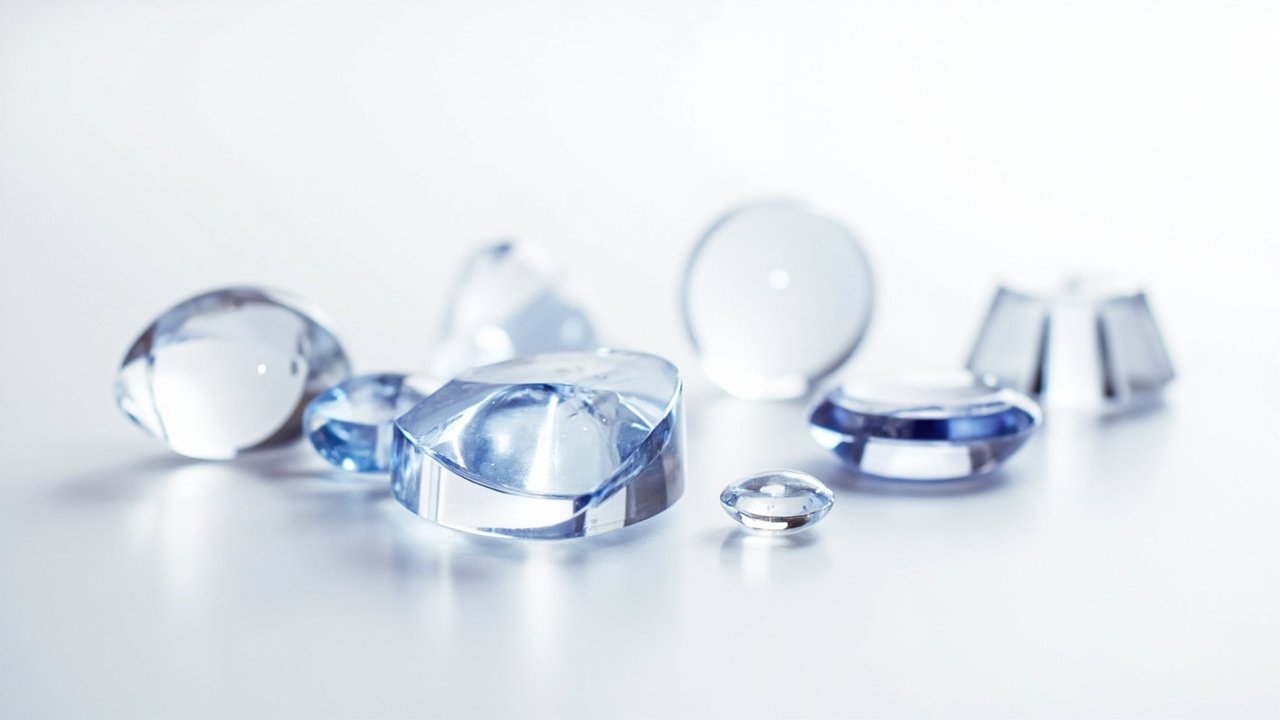
Standard sapphire optical components are typically limited to circular lenses and flat windows. Custom manufacturing enables complex geometries that standard catalog items cannot provide.
Available custom geometries:
| Geometry Type | Description | Typical Applications |
|---|---|---|
| Aspheric lenses | Non-spherical profiles that eliminate spherical aberration | Laser focusing optics, beam shaping |
| Spherical domes | Dome-shaped windows for wide-angle optical access | Environmental sensors, missile seekers |
| Tapered windows | Windows with angled or tapered sidewalls | Fluid analysis cells, spectroscopic cells |
| Multi-element assemblies | Two or more sapphire elements bonded or mounted together | Compound lens systems, hybrid optics |
| Micro-optics | Small features below 5mm diameter | Fiber optic collimators, miniaturized sensors |
| Custom prism geometries | Non-standard prism angles and facet configurations | Polarization optics, beam splitters |
Size Range
| Category | Size Range | Machining Challenge |
|---|---|---|
| Micro optics | 1–5mm diameter | Fragility, fixturing, metrology |
| Standard precision | 5–50mm diameter | Most common range, well-established processes |
| Large format | 50–200mm diameter | Grinding/polishing time, warpage control |
| Extra-large | 200mm+ diameter | Specialized equipment required, higher cost |
Surface Quality Specifications
Surface quality is specified using scratch-dig standards or interferometric measurements:
- Scratch-Dig: Standard optical surface quality notation (e.g., 60-40, 20-10)
- Surface Accuracy: Peak-to-valley wavefront error (e.g., λ/4 at 632.8nm)
- Surface Roughness: Ra values from 0.1nm to 10nm depending on application
Coating Customization
Coatings significantly extend sapphire component performance:
- Single-layer MgF₂ AR coating: Reduces reflectance to ~1.5% per surface (visible to NIR)
- Multi-layer broadband AR: Reduces reflectance to <0.5% per surface across broad wavelength ranges
- DLC coating: Adds scratch and abrasion resistance for harsh environments
- Metallization: Gold or aluminum coatings for MIR/LWIR reflecting surfaces
Evaluating Custom Sapphire Suppliers: Key Questions
Manufacturing Capability Questions
-
"What percentage of your manufacturing do you perform in-house?"
Subcontracting introduces quality variance and schedule risk. A capable supplier performs core machining, grinding, and polishing in-house, with coating either in-house or from a qualified, controlled subcontractor. -
"What is your tolerance capability for complex geometries?"
Ask for actual process capability data (Cpk values) for geometries similar to your requirements. Do not accept "we can do it" without data. -
"What metrology equipment do you have for inspection?"
Critical inspection equipment includes: interferometers for surface accuracy, spectrophotometers for transmission, CMM or optical comparators for dimensional measurement. -
"Do you offer prototype runs before production commitment?"
Prototype runs validate manufacturability, identify process issues, and establish baseline quality before volume production. Suppliers that refuse prototypes are a red flag.
Engineering Support Questions
-
"Can you provide design for manufacturability (DFM) feedback?"
A good custom supplier should identify geometry features that are manufacturing risks before accepting your purchase order, not after. -
"What is your process development timeline for new geometries?"
New complex geometries require process development time. Expect 4–8 weeks for first article development, with additional time for coating process development if coatings are required. -
"Do you provide manufacturing data packages (MDP) for qualification?"
MDP typically includes process flow documentation, in-process inspection data, final inspection results, and material certificates. Essential for aerospace and medical device qualifications.
Common Custom Sapphire Applications by Industry
Industrial Sensors and Monitoring
Custom sapphire windows for industrial environments must survive high temperature, pressure, corrosive chemicals, and mechanical stress. Typical custom requirements include large-format windows (>100mm diameter), tapered geometries for pressure vessels, and multi-layer coatings for chemical vapor resistance.
Typical custom specifications:
- Size: 50–200mm diameter
- Temperature rating: 500°C–2000°C depending on application
- Surface quality: 60-40 scratch-dig minimum
- Coatings: AR or DLC depending on environment
Medical Device OEM
Medical device applications require custom sapphire geometries to fit device-specific optical systems. Endoscopic imaging systems, laser surgical instruments, and blood analysis equipment all require non-standard sapphire geometries.
Typical custom specifications:
- Size: 3–30mm diameter
- Surface roughness: Ra < 0.1nm for imaging optics
- Sterilization compatibility: 134°C autoclave or EtO
- Documentation: ISO 10993 compliance documentation
Defense and Aerospace Optics
Defense optical systems require custom sapphire windows and lenses that meet stringent environmental and performance specifications. Custom requirements include missile seeker domes, airborne reconnaissance windows, and thermal imaging optics.
Typical custom specifications:
- Size: 30–150mm diameter
- Surface accuracy: λ/8–λ/4 at 632.8nm
- Environmental: MIL-SPEC thermal cycling, vibration, humidity
- Coatings: Multi-layer broad-band AR,耐久AR
Laser System Optics
High-power laser systems require custom sapphire components with specific LIDT (laser induced damage threshold) specifications. Sapphire lenses, windows, and beam splitters are tailored to specific laser wavelengths and power densities.
Typical custom specifications:
- LIDT documentation at specific wavelengths (2.94μm Er:YAG, 1064nm Nd:YAG)
Note: Sapphire is opaque at 10.6μm (CO₂ laser wavelength); for CO₂ laser applications, ZnSe or GaAs components are required. - Surface quality: 20-10 or better scratch-dig for high-power applications
- Anti-Reflection coatings with measured LIDT values
How to Specify Custom Sapphire Components in Your RFQ
Providing complete specifications in your request for quote significantly improves accuracy and reduces back-and-forth clarification cycles.
Essential specifications:
| Specification | What to Include |
|---|---|
| Geometry | Drawing with GD&T, or detailed description with all dimensions and tolerances |
| Material | Sapphire (Al₂O₃), grade (KY or HEM), minimum purity requirement |
| Size | Diameter, thickness, any non-circular dimensions |
| Surface quality | Scratch-dig specification or Ra roughness requirement |
| Surface accuracy | Wavefront error tolerance if interferometric measurement required |
| Transmission | Wavelength range and minimum transmission % at each wavelength |
| Coatings | Type, wavelength range, measured performance data required |
| Quantity | Prototype quantity, pilot quantity, production volume estimate |
| Timeline | Prototype delivery date, production start date |
| Documentation | Inspection reports, material certificates, batch traceability, ISO 10993 documentation if medical |
Why Engineers Choose Wanbaotek for Custom Sapphire Optics
Wanbaotek specializes in custom sapphire optical components for demanding applications. Our engineering team has delivered custom sapphire solutions for industrial monitoring systems, medical device OEM, defense optics, and laser system manufacturers.
Our custom sapphire capability:
- In-house manufacturing: CNC machining, grinding, precision polishing, and metrology all performed in our facility. Complete control over process quality and schedule.
- Engineering support: DFM feedback, process development, and manufacturing data packages included with custom component programs.
- Prototype to production: Fast prototype turnaround (4–6 weeks for first articles) with seamless scale-up to monthly production volumes.
- Full metrology suite: Interferometric surface measurement, spectrophotometric transmission, CMM dimensional inspection, and LIDT testing available.
- Documentation packages: Complete material certificates, process flow documentation, and batch traceability records for quality-critical applications.
Custom sapphire RFQ: Submit your specifications for a detailed quote. Our engineering team responds within 24 hours with pricing, feasibility assessment, and manufacturing timeline.
FAQ: Custom Sapphire Optical Components
Q: What is the minimum order quantity for custom sapphire components?
A: Custom sapphire components typically require MOQ of 10–25 pieces per configuration due to tooling and process development investment. Prototype quantities of 1–5 pieces are available at higher unit cost. Contact us with your specifications for an accurate quote.
Q: How long does it take to develop a custom sapphire component from design to first article?
A: For standard custom geometries (non-standard sizes or tolerances, standard coatings), first article delivery is typically 4–6 weeks. For complex geometries (aspheric surfaces, multi-element assemblies, new coating development), expect 6–10 weeks for first article qualification.
Q: What tolerances can custom sapphire manufacturing achieve?
A: Standard custom tolerances are ±25μm for dimensional features and ±0.5° for angular features. Tighter tolerances (±10μm or better) are achievable for most geometries with extended process development. Confirm tolerance capability with your supplier for your specific requirements.
Q: Can custom sapphire components include bonded multi-element assemblies?
A: Yes. Wanbaotek offers custom multi-element sapphire optical assemblies using optical bonding or mechanical mounting. Bonded assemblies require careful coefficient of thermal expansion (CTE) matching and adhesive selection for temperature-stable performance.
Q: How do I verify custom sapphire components meet my specifications?
A: Custom sapphire components should be supplied with complete inspection data including dimensional measurement results, surface quality verification, and transmission measurement data. Request these documents as standard deliverables in your purchase order, not as an add-on service.
Related Articles
- Sapphire Lens Overview
- Sapphire Precision Components Applications
- How to Choose a Sapphire Lens Supplier
- Precision Sapphire Machining