
Sapphire Material Properties for Medical Grade Applications
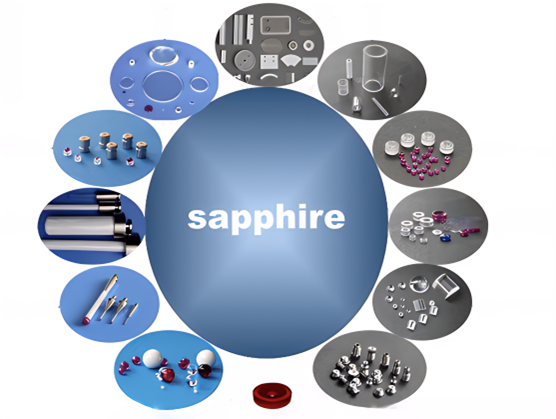
Sapphire Material Properties for Medical Grade Applications
Chemical Composition and Purity
Medical grade sapphire components require high-purity synthetic sapphire to ensure consistent optical and mechanical properties:
Target specification: 99.99% Al₂O₃ minimum purity
| Impurity Type | Typical Concentration | Effect on Sapphire |
|---|---|---|
| Cr (Chromium) | <10 ppm | Imparts pink/red hue (Ruby variant) |
| Ti (Titanium) | <5 ppm | Slight absorption in UV |
| Fe (Iron) | <5 ppm | Minor IR absorption |
| Mg (Magnesium) | <20 ppm | Affects crystal growth |
| Si (Silicon) | <10 ppm | Minimal effect |
Why purity matters: Impurities create optical absorption bands, scatter sites, and crystal boundary weaknesses. High-purity sapphire maintains consistent transmission across the wavelength range your application requires.
Specification language for procurement documents:
Material: Synthetic sapphire (Al₂O₃), single crystal
Growth method: Kyropoulos (KY) or Heat Exchanger Method (HEM)
Minimum purity: 99.99% Al₂O₃
Trace element analysis: Supplier to provide with each lot
Crystal Growth Method
The method used to grow synthetic sapphire affects crystal quality, defect density, and optical homogeneity:
Kyropoulos (KY) Method: Slow crystal growth from melt, producing large, high-quality boules with excellent optical homogeneity. Preferred for precision optics requiring lowest defect density.
Heat Exchanger Method (HEM): Growth using heat exchange to control solidification, producing large blocks with good structural integrity. Suitable for larger components where KY boule size is limiting.
Specification language:
Crystal growth: KY or HEM (supplier discretion for standard items;
required method specified for critical applications)

Application guide: For high-end imaging optics (endoscopy, surgical cameras), KY/HEM is mandatory for lowest defect density. For standard protective windows or non-imaging sensors, consult with Wanbaotek for cost-effective alternatives (EFG or other methods).
Optical Transmission Requirements
Specify transmission at the wavelengths your application uses. Sapphire transmits from UV (0.2μm) through visible to mid-IR (6μm), but transmission varies with wavelength and thickness:
Typical specification for visible/NIR applications:
Minimum transmission: ≥85% at 550nm for 2mm thickness
≥90% across 400–700nm for 1mm thickness
Measurement: Per MIL-STD-810 or equivalent
For IR applications (MWIR 3–5μm):
Sapphire transmits through mid-IR to approximately 6μm. For the 3–5μm range:
- Typical transmission: ≥85% at 4μm for 2mm thickness
- Include transmission curve with each shipment
Note: Sapphire is not transparent beyond 6μm. For LWIR (8–14μm) applications, consider ZnS or Germanium.
Surface Quality Specifications for Medical Sapphire Components
Surface Roughness (Ra)
Surface roughness directly affects light scatter and image quality. For medical imaging applications, specify Ra values that match your optical performance requirements:
| Application | Surface Roughness Requirement | Typical Standard |
|---|---|---|
| Endoscopic imaging | Ra < 0.1nm | Optical quality; interferometric measurement |
| Laser delivery | Ra < 0.5nm | High-power laser; low scatter critical |
| General imaging | Ra < 1nm | Standard medical imaging |
| Non-imaging windows | Ra < 10nm | Inspection windows, protective covers |
| Sensor protection | Ra < 20nm | Light diffuser, environmental windows |
Measurement method: Specify measurement technique to avoid ambiguity:
- Interferometric profilometry: Best for Ra < 0.5nm
- Phase-shift interferometry: Standard for optical surfaces
- AFM (Atomic Force Microscopy): Reference method for Ra < 0.1nm
Specification language:
Surface roughness: Ra < 0.1nm measured by interferometric profilometry
Measurement area: 1mm × 1mm centered on optical axis
Reporting: Supplier to provide surface map with each shipment
Scratch-Dig Specifications
Scratch-dig is a traditional optical surface quality specification that defines acceptable surface defects:
| Surface Quality Class | Scratch | Dig | Typical Application |
|---|---|---|---|
| 20-10 | 20 | 10 | Laser systems, high-power applications |
| 40-20 | 40 | 20 | Precision imaging, medical endoscopy |
| 60-40 | 60 | 40 | General imaging, sensor protection |
| 80-50 | 80 | 50 | Non-critical windows |
Specification language:
Surface quality: 40-20 scratch-dig per MIL-PRF-13830B
Inspection: Visual inspection under 100W incandescent lamp at 30cm distance
Dimensional and Geometric Tolerances for Medical Sapphire
Critical Dimensions
Specify critical dimensions with appropriate tolerances. Over-specifying tolerances increases cost unnecessarily; under-specifying causes assembly problems.
Typical tolerance framework:
| Dimension Type | Tolerance Range | When to Tighten |
|---|---|---|
| Diameter (tight) | ±10μm | Critical for interferometric mounting |
| Diameter (standard) | ±25μm | Most optical mounts |
| Diameter (loose) | ±50μm | Non-critical clearances |
| Thickness | ±25μm | Standard lens retention |
| Center thickness variation | ±10μm | High-power laser focus stability |
| Surface angle | ±0.5° | Standard optical alignment |
| Surface angle (tight) | ±0.1° | Precision imaging systems |
Specification language:
Diameter: Ø[XX.X] ±0.025mm
Thickness: [X.X] ±0.025mm
Surface parallelism: <0.01mm
Center thickness variation: <0.010mm
Angular tolerance: ±0.5° on surface normal
GD&T for Complex Geometries
For sapphire components with complex geometries, use Geometric Dimensioning and Tolerancing (GD&T) to communicate requirements unambiguously:
- Use datum references for critical surfaces
- Specify form tolerances (flatness, cylindricity) where critical
- Use position tolerances for hole locations and feature centers
- Include maximum material condition (MMC) modifiers where appropriate
When GD&T is required: Any sapphire component with more than three critical dimensions, non-standard geometries, or critical interface requirements should be specified with GD&T on a drawing.
Coating Specifications for Medical Sapphire Optics
Anti-Reflective (AR) Coatings
AR coatings reduce surface reflectance from ~14% (uncoated sapphire) to <1% per surface:
Common coating specifications:
| Coating Type | Spectral Range | Reflectance | Typical Application |
|---|---|---|---|
| Single-layer MgF₂ | 400–700nm | <1.5% per surface | Visible imaging |
| Broadband AR | 400–700nm | <0.5% per surface | Medical endoscopy |
| NIR AR | 700–1000nm | <0.5% per surface | NIR fluorescence imaging |
| MWIR AR | 3–5μm | <1% per surface | MWIR thermal imaging |
| LWIR AR | 8–12μm | <1% per surface | LWIR thermal imaging |
Specification language:
AR coating: Broadband anti-reflective, 400–700nm
Reflectance: <0.5% per surface at normal incidence
Coating adhesion: Tape test per MIL-STD-13830
Temperature stability: No degradation at 134°C autoclave cycles
Diamond-Like Carbon (DLC) Coatings
DLC coatings add scratch and abrasion resistance for harsh environments:
Specification language:
DLC coating: Applied to [surface designation]
Film thickness: 1–3μm
Scratch resistance: No scratch from steel wool #0000
Adhesion: No delamination after 500 autoclave cycles at 134°C
Documentation Requirements for Medical Grade Sapphire
Certificate of Conformance
Every shipment of medical grade sapphire components should include a Certificate of Conformance (C of C) documenting:
Required C of C elements:
- Part number and revision
- Quantity in shipment
- Lot/batch number and date of manufacture
- Material certification (purity, crystal growth method)
- Actual measured values for critical dimensions
- Surface quality inspection results
- Coating specifications and test results (if applicable)
- Statement of conformance to specification
Material Data Sheets
Medical device OEMs typically require a Material Data Sheet (MDS) for sapphire components:
MDS content requirements:
- Chemical composition and purity
- Crystal growth method
- Physical properties (density, hardness, thermal expansion)
- Optical properties (transmission curve, refractive index)
- Mechanical properties (strength, modulus)
- Chemical resistance data
- Biocompatibility status (ISO 10993)
ISO 10993 Documentation
For medical device regulatory submissions, ISO 10993 documentation is typically required:
Documentation package:
- ISO 10993-5 cytotoxicity test report (from ISO 17025 accredited lab)
- Chemical characterization report (ISO 10993-18)
- Biocompatibility declaration referencing applicable test battery
- Batch traceability records
Specification language for RFQ:
ISO 10993 documentation: Supplier to provide ISO 10993-5 cytotoxicity
test report and chemical characterization documentation for material
and manufacturing process. Documentation must be from ISO 17025
accredited testing laboratory.
Application-Specific Specification Examples
Endoscopic Imaging Objective Lens
Material: KY synthetic sapphire, 99.99% Al₂O₃
Diameter: Ø3.0 ±0.015mm
Thickness: 1.5 ±0.015mm
Surface quality: Ra <0.1nm, interferometric measurement
Surface accuracy: λ/10 at 632.8nm
Coating: Broadband AR, 400–700nm, <0.5% reflectance per surface
Sterilization: 500 cycles at 134°C autoclave, no degradation
Documentation: ISO 10993-5 test report, C of C with transmission data
Packaging: Cleanroom packaging, nitrogen purge
Surgical Laser Focusing Lens
Material: HEM synthetic sapphire, 99.99% Al₂O₃
Diameter: Ø12.0 ±0.025mm
Thickness: 3.0 ±0.025mm
Surface quality: 20-10 scratch-dig
Surface accuracy: λ/8 at 632.8nm
Coating: Single-layer MgF₂ AR, 1064nm, reflectance <0.5%
LIDT: >20 J/cm² at 1064nm, 10ns pulse (test report required)
Sterilization: Autoclave compatible, EtO compatible
Documentation: LIDT test data, C of C, transmission curve
Medical Sensor Window
Material: Synthetic sapphire, 99.99% Al₂O₃
Diameter: Ø25.0 ±0.050mm
Thickness: 2.0 ±0.050mm
Surface quality: Ra <5nm
Parallelism: <0.02mm
Coating: None (uncoated)
Sterilization: Autoclave, EtO, gamma compatible
Documentation: Material certificate, C of C
FAQ: Medical Grade Sapphire Specifications
Q: Should I specify Ra or scratch-dig for surface quality?
A: For medical imaging applications, Ra provides more meaningful specification because it quantifies actual surface roughness that affects optical performance. Scratch-dig is a defect-based specification that defines acceptable defects but does not quantify surface quality directly. For critical imaging optics, specify both: Ra for surface quality and scratch-dig for defect limits.
Q: What is the tightest tolerance achievable for sapphire components?
A: Sapphire CNC machining can achieve ±5μm on diameter for standard geometries. Tighter tolerances (±2μm) are possible for small components with extended process development but increase cost significantly. Confirm achievable tolerances with your supplier before specifying tighter than ±10μm on standard items.
Q: How do I specify transmission requirements for IR applications?
A: Specify minimum transmission percentage at each wavelength your application uses, measured per agreed test method. For broadband IR applications, include a transmission curve requirement in your specification. Request actual transmission measurement data with each shipment rather than relying on theoretical values.
Q: Do I need to specify crystal orientation for my sapphire component?
A: Crystal orientation matters when optical properties (birefringence, transmission) vary with crystallographic direction, or when thermal expansion anisotropic effects could cause stress in your mounting design. For most standard lens geometries, supplier-controlled orientation is acceptable. Specify required orientation only if your application demands it.
Q: What inspection documentation should I require with sapphire shipments?
A: Minimum: Certificate of Conformance with actual measured values for all critical dimensions, surface quality verification, and transmission measurement data (if optical performance specified). For medical device applications, also require ISO 10993 documentation package and batch traceability records.
Related Articles
- ISO 10993 Sapphire Medical Lens Procurement Guide
- Sapphire Lens Overview
- Precision Sapphire Technologies: Custom Optical Solutions