
Sapphire vs Fused Silica Optical Window: Selection Guide

When you need high mechanical strength, pressure resistance, abrasion tolerance, strong chemical durability, or extreme thermal shock performance, choose sapphire over fused silica. Fused silica is preferred for low-stress UV/visible applications where cost and transmission dominate.
Introduction
In many OEM programs, a sapphire vs fused silica optical window decision is triggered by recurring field failures rather than initial design intent. A laser OEM may see acceptable lab performance but unacceptable field fracture rates, forcing a reassessment of material choice. The core trade-off is not optical quality alone but lifecycle reliability under real mechanical, thermal, and chemical stress.
Sapphire increases upfront cost but significantly improves survivability under harsh environments. Fused silica minimizes cost and excels in UV transmission and thermal stability in controlled systems. The real engineering task is identifying which failure mode dominates system risk and converting that into a defensible material specification.
This article compares both materials across performance, durability, UV behavior, thermal shock, and cost, and concludes with a structured selection workflow and decision matrix.
Sapphire vs Fused Silica: Performance Trade-Offs at a Glance
Material selection begins with intrinsic property differences that define system limits. A sapphire window is typically selected when mechanical robustness dominates, while a fused silica window is selected when optical stability and cost efficiency dominate.
Sapphire exhibits Knoop hardness around 2200 versus roughly 500 for fused silica, making it significantly more resistant to scratching and surface damage. Flexural strength is commonly treated as ~7× higher, while density differs (3.98 vs 2.20 g/cm³), influencing weight-sensitive designs. Mohs hardness is 9 vs 7, reinforcing abrasion resistance advantages. Sapphire also tolerates higher softening temperatures (~2000°C vs ~1700°C), making it more stable under extreme thermal exposure.
Optically, fused silica offers slightly deeper UV transmission cutoff (~180 nm) compared with sapphire (~150 nm depending on orientation), making it preferable in extreme UV systems. Sapphire extends better into broader spectral and IR-adjacent regimes, supporting multi-band optical systems. These differences define application boundaries more than absolute performance ranking.
The key engineering insight is that sapphire vs fused silica optical window selection is driven by failure mode dominance, not material superiority. One is optimized for survival under stress, the other for precision under controlled conditions.
Why Sapphire Windows Survive Harsh Environments
Sapphire’s reliability advantage comes from mechanical and chemical resilience rather than optical performance alone. It maintains surface integrity under conditions that progressively degrade fused silica performance.
Abrasion resistance is a primary factor. Sapphire is ~4× harder than fused silica, allowing it to retain optical clarity under particle impact, cleaning cycles, and mechanical contact. A fused silica window is more prone to micro-scratching, which increases scatter and reduces long-term transmission stability.
Pressure performance is equally important. Sapphire provides ~7× higher flexural strength, making it suitable for sealed systems exceeding ~0.3 MPa differential pressure. Fused silica requires conservative mounting and lower stress design margins to avoid crack initiation at edges or surface defects.
Chemical durability is another differentiator. Sapphire resists broad chemical environments across pH 0–14, while fused silica is vulnerable to HF attack and hot alkaline etching. This limits fused silica use in aggressive cleaning or plasma environments.
Thermal shock resistance further reinforces sapphire suitability. It tolerates gradients above ~100°C/s, while fused silica performs best under moderate thermal cycling but becomes vulnerable under rapid localized heating or quenching.
Across industrial laser systems, sapphire window components are commonly exposed to scattered beam power and particulate back-reflection. In these environments, sapphire becomes the default because degradation mechanisms accumulate slowly, while fused silica failure tends to be earlier and more abrupt under combined stress.
Where Fused Silica Still Wins: UV, Weight, and Clean Labs
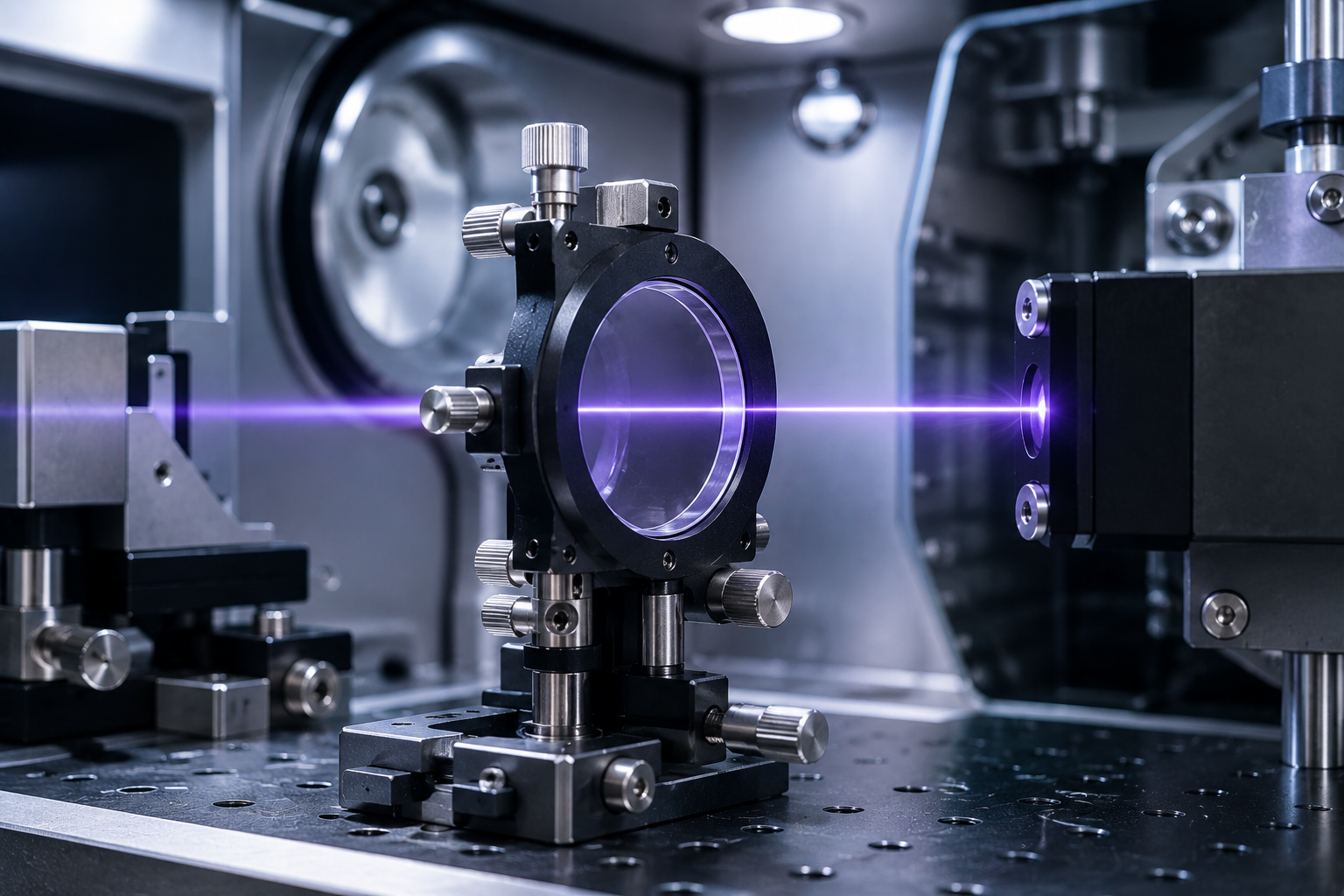
Despite sapphire’s durability advantages, fused silica remains dominant in several high-value optical domains where stability and transmission outweigh mechanical robustness.
Its strongest advantage is deep UV transmission. Fused silica supports high efficiency in the 180–250 nm range, making it essential for excimer lasers, UV sterilization systems, fluorescence microscopy, and lithography tools operating at 193 nm and 248 nm. In these systems, transmission loss directly impacts resolution or process consistency, making fused silica the default material.
Thermal expansion behavior is equally critical. With a CTE of ~0.55 × 10⁻⁶/K versus sapphire’s ~5–7 × 10⁻⁶/K, fused silica provides near-zero dimensional drift. This stability is essential in interferometers, FTIR systems, and precision metrology platforms where nanometer-scale shifts matter.
Weight is another factor. At 2.20 g/cm³ versus 3.98 g/cm³, fused silica enables lighter optical assemblies for aerospace payloads, portable analyzers, and handheld sensors.
Cost efficiency reinforces adoption. In high-volume systems, fused silica windows are often 5–10× cheaper, making them ideal when replacement is rare and environmental stress is controlled.
Fused silica is therefore optimized for three domains: deep UV optics, ultra-stable interferometry, and cost-sensitive low-stress systems.
Thermal Shock, Pressure, and Service Life Trade-Offs
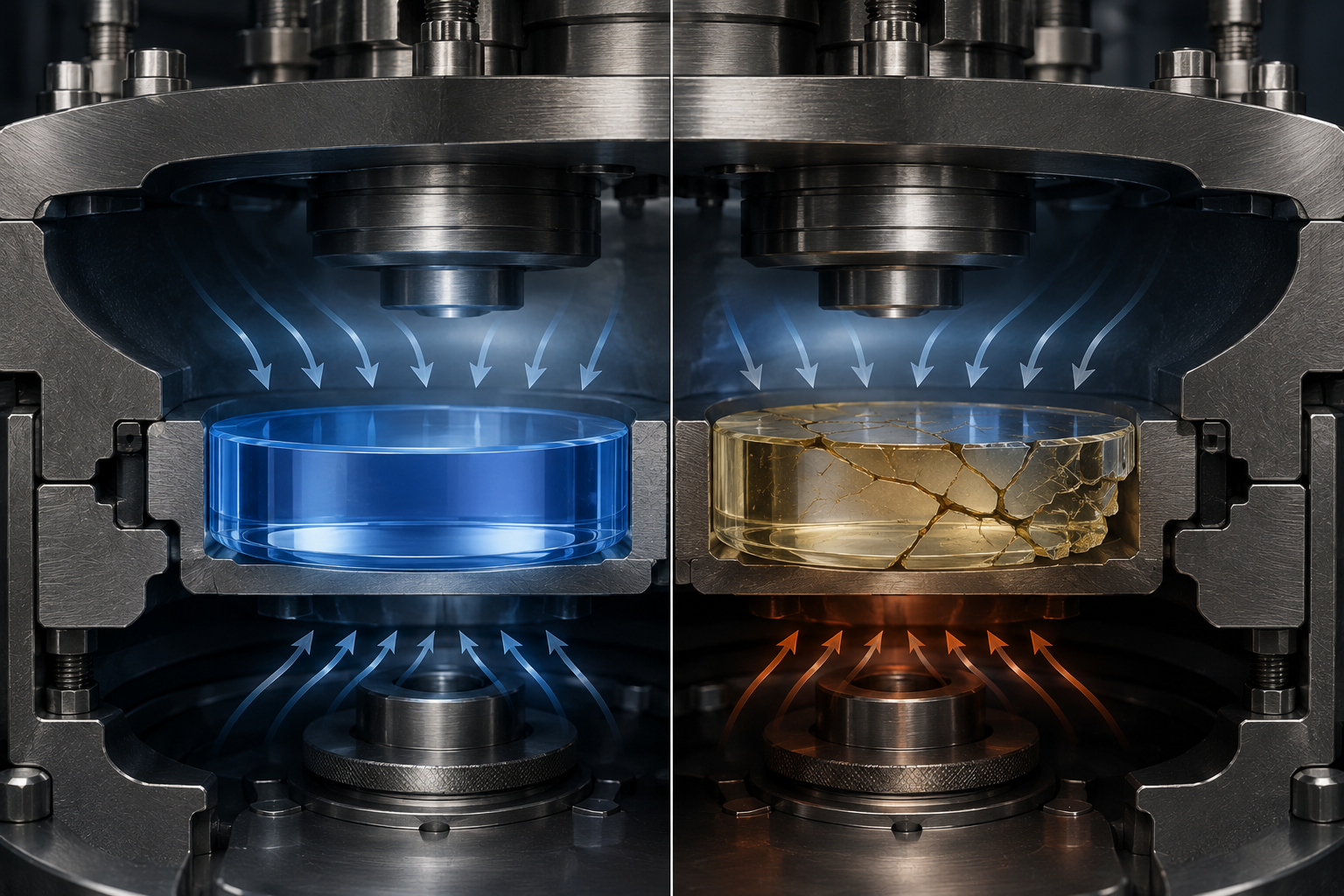
In real operating environments, combined stress defines lifecycle performance more than individual properties.
Thermal shock resistance is a key separator. Sapphire exhibits an R₁' value of ~35 W/m versus ~7 W/m for fused silica, giving it roughly a 5× advantage in allowable thermal gradient before fracture initiation.
Pressure capability also differs significantly. Sapphire can exceed ~1 MPa in supported geometries, while fused silica typically remains within ~0.3–0.5 MPa limits depending on edge quality and mounting.
Service life divergence becomes visible under combined stress. Sapphire typically lasts 5–10 years in abrasive and thermally cycled environments, while fused silica often requires replacement within 6–18 months due to surface degradation or stress fatigue.
Total cost of ownership often reverses initial assumptions. A sapphire window at $200 lasting 5 years results in ~$40/year. A fused silica window at $30 replaced four times over the same period results in higher total material cost plus downtime and labor overhead. In production systems, downtime often dominates cost more than part price.
How to Specify Your Optical Window: A 5-Step Selection Workflow
Step 1 defines failure mode dominance: abrasion, thermal shock, pressure, chemical exposure, or optical degradation. This determines whether sapphire or fused silica should be evaluated first.
Step 2 quantifies operating conditions: temperature gradients, pressure differential, pH range, particulate exposure, and cleaning cycles. Without numeric bounds, material selection remains speculative.
Step 3 maps requirements to properties such as hardness, flexural strength, density, and thermal expansion, narrowing candidate materials.
Step 4 validates via prototyping. Both sapphire window and fused silica window samples should be tested with transmission curves, surface roughness, and mechanical inspection.
Step 5 evaluates total cost of ownership over a 5-year lifecycle, including replacement frequency, downtime, and maintenance overhead.
Decision rule: if mechanical or environmental stress dominates, specify sapphire. If UV transmission, weight, or cost dominates, specify fused silica.
Conclusion

Sapphire dominates under mechanical and environmental stress, while fused silica dominates in UV, weight, and cost-sensitive optical systems. The correct choice depends on which failure mode defines system risk.
| Decision Driver | Sapphire Recommendation | Fused Silica Recommendation | |
|---|---|---|---|
| Bottom Line | |||
| Pressure differential > 0.3 MPa | Default | Acceptable with conservative mounting | Sapphire |
| Abrasive or particle-laden environment | Default | Avoid | Sapphire |
| Strong acids / bases (pH < 3 or > 11) at > 60°C | Default | Avoid | Sapphire |
| Thermal cycling > 50°C/s gradient | Default | Acceptable for moderate cycling | Sapphire |
| Deep UV optics (< 200 nm) | Acceptable (A-plane) | Default | Fused Silica |
| Weight-sensitive (aerospace, portable) | Acceptable | Default | Fused Silica |
| Budget-driven, room-temp, clean lab | Avoid | Default | Fused Silica |
| Mixed: durability + cost concern | Default with TCO justification | Cost-engineered fallback | Sapphire |
We engineer both materials and base recommendations on dominant constraints rather than material preference. In industrial laser, medical, defense, and analytical systems, sapphire is often the starting point. In deep UV lithography, interferometry, and controlled lab environments, fused silica remains optimal. The decision matrix is a practical baseline for engineering review.
Get a Free Material Selection Review
Choosing between sapphire and fused silica is rarely obvious from a spec sheet alone. Wanbaotek's engineering team can review your operating envelope (wavelength, pressure, thermal, chemical) and return a written recommendation within 3 business days, with sample quotation for both materials at your specified geometry.
Request a Free Selection Review →
Browse Sapphire Window Products →
Related Articles
- Sapphire Window for Industrial Applications: Material Overview
- Material Properties Comparison: Sapphire, Fused Silica, and Others
- Precision Sapphire Components: Custom Manufacturing Capabilities
- Why Synthetic Sapphire Dominates LWIR Thermal Imaging Windows
- Sapphire Material Properties for Medical-Grade Applications