
Ceramic Bushing Material Selection: ZrO₂ vs Si₃N₄ vs Al₂O₃ vs Sapphire
Featured Snippet
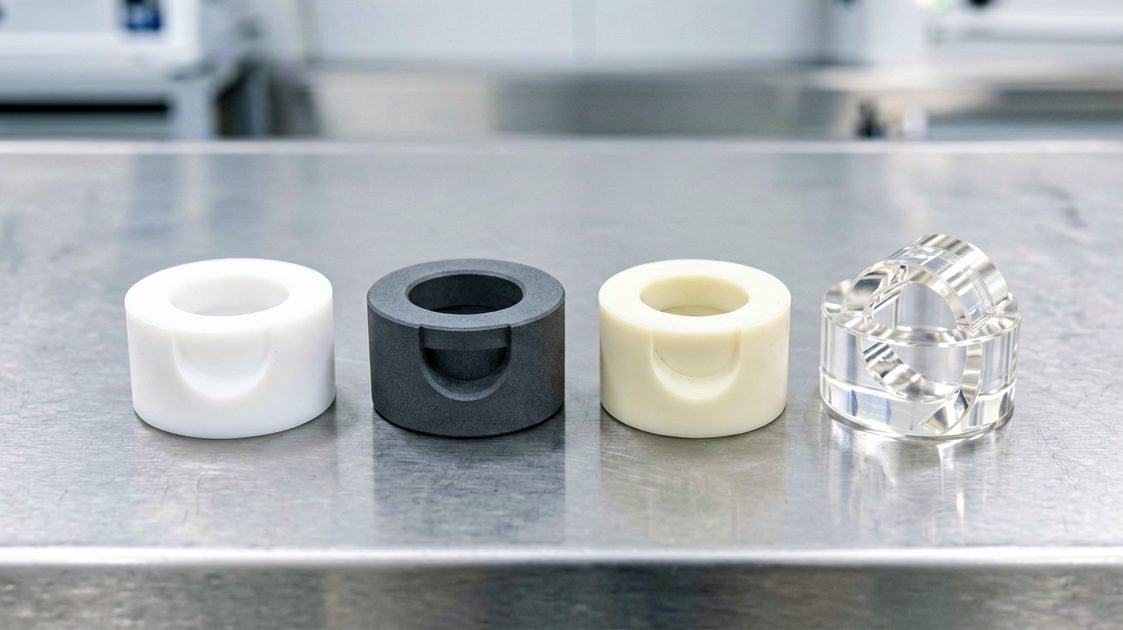
When selecting a ceramic bushing for industrial pumps, flow meters, or instrumentation, choose zirconia (ZrO₂) for fracture toughness, silicon nitride (Si₃N₄) for high-temperature strength, alumina (Al₂O₃) for cost-effective wear resistance, or synthetic sapphire for scratch-critical and broadband optical applications. Each material trades hardness, toughness, thermal stability, and cost differently.
Introduction
You're sourcing a ceramic bushing for a pump, flow meter, or high-temperature instrumentation system. The spec sheet lists ZrO₂, Si₃N₄, Al₂O₃, and sapphire, and the trade-offs are open. One wrong call means a field failure, a warranty claim, or a redesign.
This guide cuts the noise. We compare the four materials across the dimensions that matter in design review: hardness, fracture toughness, thermal stability, chemical resistance, manufacturability, and total cost of ownership. In our experience, the call usually reduces to two variables: the binding failure mode and the cost of a field failure. Use the decision matrix at the end to shortlist suppliers. For related component-selection guidance, see our ceramic plunger material selection guide and material properties comparison.
1. Zirconia Bushing (ZrO₂) — Toughness-First Engineering
Zirconia bushings fit applications where impact loading, thermal shock, and crack propagation dominate failure. Three grades dominate: Y-TZP (yttria-stabilized tetragonal zirconia polycrystal), partially stabilized (PSZ), and ceria-stabilized ZrO₂. For precision bushings, Y-TZP is the usual default, combining high flexural strength with high fracture toughness.
Key Properties of Y-TZP Zirconia Bushing:
| Property | Typical Value |
|---|---|
| Flexural Strength | 900–1200 MPa |
| Fracture Toughness (KIC) | 6–10 MPa·m½ |
| Hardness (HV) | 1200–1400 |
| Density | 6.0–6.1 g/cm³ |
| Thermal Conductivity | 2.0–2.5 W/(m·K) |
| Max Service Temperature | ~1000°C (short-term) |
| Chemical Resistance | Excellent vs. alkalis and most mineral acids; not resistant to HF, hot concentrated phosphoric acid, or molten metals |
The defining advantage of zirconia is transformation toughening: under stress, metastable tetragonal grains transform to monoclinic phase, expand slightly, and compress any propagating crack. This is why a zirconia bushing survives shock loading and vibration better than an alumina ceramic bushing in abrasive slurry service, where edge chipping — not steady abrasion — is usually the failure mode. If pure wear rate is the only constraint, 99.5% alumina typically still gives the longer bore life.
Zirconia has real limitations. Its thermal conductivity is low — below silicon carbide and tungsten carbide bushings — so thermal gradients build up during high-speed rotation. It also suffers from low-temperature degradation (LTD) in moist environments, with the degradation window running roughly between 100°C and 300°C and peak risk at 200–250°C: the tetragonal phase transforms over time, causing surface microcracking — a latent failure mode that never shows up on a datasheet.
💡 Key Insight: For an abrasive-slurry pump bushing at 1500 RPM, zirconia can outlast alumina where chipping is the failure mode, but at higher unit cost. The break-even point depends on your downtime cost per hour.
🚩 Red Flag: Do not specify standard Y-TZP in steam or condensing high-humidity service without confirming LTD resistance — that window is the worst case. Suppliers may blend silica or use ceria-stabilized grades; ask for the stabilization chemistry.
2. Silicon Nitride Bushing (Si₃N₄) — High-Temperature Strength and Thermal Shock
Silicon nitride bushing (Si₃N₄) occupies a unique position: few structural ceramics combine high strength at temperature with excellent thermal shock resistance and moderate toughness. For bushings in high-temperature pumps, gas turbine instrumentation, or chemical processing equipment, Si₃N₄ resolves a thermal-mechanical trade-off no single ceramic solves alone.
Key Properties of Reaction-Bonded and Hot-Pressed Si₃N₄:
| Property | Reaction-Bonded (RBSN) | Dense / Hot-Pressed (HP-Si₃N₄) |
|---|---|---|
| Flexural Strength (RT) | 150–350 MPa | 450–1000 MPa |
| Flexural Strength (1200°C) | Not recommended — free Si oxidizes | 250–450 MPa (inert, low-O₂; indicative, grade-dependent) |
| Fracture Toughness (KIC) | 1.5–3.5 MPa·m½ | 4.2–7.0 MPa·m½ |
| Thermal Conductivity | 4–10 W/(m·K) | 30–43 W/(m·K) |
| Thermal Expansion Coefficient | 3.0–3.5 × 10⁻⁶/K | 3.0–3.5 × 10⁻⁶/K |
| Density | 2.4–2.7 g/cm³ | 3.15–3.30 g/cm³ |
| Relative Density | 70–88% | 99–100% |
| Max Service Temperature | ~1100°C (in air, porous body) | ~1400°C (inert); ~1200°C in air |
The thermal conductivity of a hot-pressed silicon nitride bushing is substantially higher than zirconia's and modestly higher than 99.5% alumina, so heat generated at the bore conducts away faster, reducing thermal gradients and cracking risk. Combined with Si₃N₄'s low thermal expansion coefficient, this gives it exceptional thermal shock resistance — critical for bushings with rapid temperature cycling.
Dense Si₃N₄ grades typically retain a significant fraction of room-temperature strength at 1000–1200°C, while many other engineering ceramics begin to soften or creep — though long-term behaviour there is usually governed by creep, oxidation, and slow crack growth rather than by room-temperature numbers.
Trade-offs: Si₃N₄ costs more than Al₂O₃ and ZrO₂: dense parts need hot-pressing or gas-pressure sintering, and machining requires diamond grinding at tight tolerances (IT6–IT7). In air, the glassy grain-boundary phase softens and oxidizes above roughly 1200°C, so dense grades and protective coatings matter in high-temperature oxidizing service.
💡 Key Insight: For demanding cyclic duty above 600°C, dense Si₃N₄ is often considered because it combines high strength at temperature with low thermal expansion and good thermal-shock resistance — but SiC and alumina can also qualify once the thermal cycle, stress level, atmosphere, and allowable dimensional drift are screened.
🚩 Red Flag: Reaction-bonded Si₃N₄ retains free silicon and a porous body (70–88% relative density), so its strength and oxidation limit fall well below dense grades — the residual silicon oxidizes, and the silicon melts at 1410°C. Above 1100°C in oxidizing service, specify hot-pressed or gas-pressure-sintered Si₃N₄.
3. Alumina Ceramic Bushing (Al₂O₃) — The Volume Workhorse
Alumina ceramic bushing (Al₂O₃) is the most widely used structural ceramic in industrial components, and for good reason: a balanced mix of hardness, chemical inertness, insulation, and manufacturability at scale. For OEM engineers managing volume orders, Al₂O₃ is often the BOM default unless a requirement forces an upgrade.
Key Properties of 95% and 99.5% Al₂O₃:
| Property | 95% Al₂O₃ | 99.5% Al₂O₃ |
|---|---|---|
| Flexural Strength | 300–400 MPa | 400–500 MPa |
| Fracture Toughness (KIC) | 3.5–4.5 MPa·m½ | 3.0–4.0 MPa·m½ |
| Hardness (HV) | 1500–1700 | 1600–1800 |
| Density | 3.6–3.8 g/cm³ | 3.9–4.0 g/cm³ |
| Thermal Conductivity | 20–30 W/(m·K) | 25–35 W/(m·K) |
| Electrical Resistivity | >10¹² Ω·cm | >10¹⁴ Ω·cm |
| Max Service Temperature | ~1600°C (melting ~2072°C) | ~1600°C |
| Unit Cost (indicative) | Baseline | Moderate |
The 95% grade is the volume workhorse where unit cost dominates: easier to sinter, significantly cheaper. The 99.5% grade delivers higher hardness and wear resistance, suiting abrasive service where bore wear life is critical.
Al₂O₃ resists a broad pH range at moderate temperature, except hydrofluoric acid, hot concentrated phosphoric acid, and hot concentrated caustic — a natural match for chemical processing and metering pumps.
Limitations: moderate fracture toughness (3.0–4.5 MPa·m½) versus ZrO₂/Si₃N₄ makes it more chip-prone under impact or thermal shock, and thermal conductivity (20–35 W/(m·K)) sits close to dense hot-pressed Si₃N₄ (30–43) and far above RBSN (4–10), yet well below SiC (120–270), which limits heat removal in high-speed duty. Manufacturability is the differentiator — green machining, pressing, and sintering are well established at scale, so Al₂O₃ stays the default specification for most industrial bushing orders.
💡 Key Insight: For standard pump and flow meter bushing applications, 95% Al₂O₃ is the usual cost-performance default. Upgrade to 99.5% when wear life or hardness is the binding constraint.
🚩 Red Flag: Do not use Al₂O₃ in hydrofluoric acid (HF), hot concentrated phosphoric acid, or hot concentrated caustic. The material dissolves rapidly, and bore dimensions degrade within hours to days depending on concentration and temperature.
4. Synthetic Sapphire Bushing — When Scratch Resistance and Optical Performance Are Non-Negotiable
Synthetic sapphire (single-crystal Al₂O₃) occupies a distinct tier. It is not a sintered ceramic but a single crystal grown by the Kyropoulos or edge-defined film-fed (EFG) method, with properties unlike polycrystalline Al₂O₃, ZrO₂, or Si₃N₄. Where scratch resistance, optical transparency, and dimensional stability are mission-critical, sapphire resolves failure modes most polycrystalline ceramics cannot.
Key Properties of Synthetic Sapphire (Single-Crystal Al₂O₃):
| Property | Synthetic Sapphire | 99.5% Al₂O₃ (polycrystalline) |
|---|---|---|
| Hardness (Mohs) | 9 | 8–9 |
| Hardness | ~2000 Knoop (≈1600–1900 HV) | 1600–1800 HV |
| Fracture Toughness (KIC) | 2.0–2.5 MPa·m½ | 3.0–4.0 MPa·m½ |
| Optical Transmission | 0.18–5.5 μm | Opaque |
| Refractive Index | 1.76–1.78 | 1.76 (bulk) |
| Thermal Conductivity | 35–46 W/(m·K) | 25–35 W/(m·K) |
| Density | 3.98 g/cm³ | 3.9–4.0 g/cm³ |
| Max Service Temperature | ~1000°C continuous in air; short excursions higher (melting 2050°C) | ~1600°C |
| Chemical Resistance | Excellent vs. most acids and alkalis; not resistant to HF or hot concentrated phosphoric acid | Same, with the same HF exception |
The Mohs 9 hardness is the defining characteristic — in the standard Mohs sequence sapphire ranks second only to diamond (10); cubic boron nitride, boron carbide, and silicon carbide also reach the 9–10 band. For bushings in pumps or flow meters exposed to particulate contamination, sand ingress, or abrasive wear, sapphire keeps a smoother bore than polycrystalline alumina, whose grain boundaries and porosity initiate scratches, and keeps bore smoothness over extended service life.
Optical transmission (0.18–5.5 μm) is irrelevant for purely mechanical bushings but critical when the bushing also serves as a view window, optical seal, or multi-spectral sensing element. In flow meters that integrate optical sensing through the bore, sapphire is often the only practical ceramic that removes the need for a separate window.
The trade-offs are significant. Synthetic sapphire has lower fracture toughness than ZrO₂ or Si₃N₄, so it chips more readily under impact or thermal shock, and it is the most expensive of the four families. Machining requires diamond tooling, and the single-crystal structure makes properties orientation-dependent (c-axis vs. a-axis).
Three scenarios justify the sapphire premium: (1) optical-sensing flow meters where the bushing is the optical path, (2) high-precision pump seals where bore finish drives seal life, and (3) extreme-environment instrumentation where scratch resistance, chemical inertness, and thermal stability must coexist.
💡 Key Insight: If your design needs both mechanical sealing performance and optical transparency (e.g., an in-line optical flow meter), synthetic sapphire removes the separate window component, cutting part count, assembly complexity, and potential leak paths.
🚩 Red Flag: Sapphire's lower fracture toughness (KIC ~2.0–2.5) makes it more sensitive to handling damage and thermal shock than ZrO₂ or Si₃N₄. Do not specify it for high-impact or high-vibration service without a dedicated shock-absorption design.
5. Material Selection Decision Matrix — Matching Application to Material
The right ceramic bushing material depends on which performance dimension binds your application. The matrix below maps common OEM use cases to the material that most often satisfies the primary driver, with secondary considerations noted. For the general classification of fine ceramics, see ISO 20507.
Decision Matrix: Ceramic Bushing Material Selection
| Application Profile | Primary Driver | Recommended Material | Secondary Consideration |
|---|---|---|---|
| Abrasive slurry pump, ambient temp, high vibration | Fracture toughness + chip resistance | ZrO₂ (Y-TZP) | Check LTD resistance for humid service |
| High-temp pump (>600°C), thermal cycling | High-temp strength + thermal shock | Si₃N₄ (hot-pressed) | Keep RBSN below ~1100°C in oxidizing atmospheres |
| Chemical metering pump, broad pH, cost-sensitive | Chemical resistance + unit cost | Al₂O₃ (95%) | Upgrade to 99.5% for abrasive media |
| Optical flow meter, multi-spectral sensing | Scratch resistance + optical transmission | Synthetic sapphire | Design for lower fracture toughness |
| High-speed spindle bushing, moderate temp | Hardness + thermal conductivity | Si₃N₄ or Al₂O₃ (99.5%) | Evaluate bearing preload and clearance |
| Semiconductor process tool, ultra-pure media | Chemical inertness + particle control | Synthetic sapphire or Al₂O₃ (99.5%) | Specify low-metal-ion grade |
| General-purpose instrumentation, volume order | Cost + manufacturability | Al₂O₃ (95%) | Standard tolerances, fast lead time |
Over a 5-year horizon, unit price is often dwarfed by field failures, warranty claims, and maintenance — a costlier zirconia bushing with longer life can be cheaper, and sapphire that removes a separate window can justify its premium at system level.
💡 Key Insight: A failure-mode-first approach often reduces iteration cycles compared to starting from a familiar material.
🚩 Red Flag: Do not select on datasheet values alone without validating performance in your actual operating environment. Lab-scale flexural strength does not always translate to field performance, especially under combined thermal, mechanical, and chemical loading.
Conclusion
Selecting the right ceramic bushing material means matching the application's primary failure mode to the material that addresses it: ZrO₂ leads on fracture toughness and impact resistance, Si₃N₄ on high-temperature strength and thermal shock, Al₂O₃ on cost-performance for volume. Synthetic sapphire is the choice when scratch resistance and optical performance are critical.
Use the matrix to identify your binding constraint, validate manufacturability and lead times with your supplier, and factor total cost of ownership — not unit price — into the final call.
Data Basis and Material Limits
Figures here are typical published ranges from datasheets and materials references, not guaranteed part properties. Ceramic performance depends on composition, sintering aid, grain-boundary phase, porosity, surface finish, and test method (flexural strength per ASTM C1161; toughness by supplier method), so grades differ. Temperature values shift with grade, atmosphere, and load. A value marked short-term is not a continuous-service rating; none of these are melting points. Long-term strength is often governed by creep, oxidation, and slow crack growth — confirm each value against supplier data.
Next Steps
We supply synthetic sapphire and alumina precision components. For zirconia and silicon nitride bushings we help define the spec and qualify a source rather than claim off-the-shelf supply. Send your operating conditions, bore geometry, and duty cycle — we will shortlist a material and confirm tolerances and lead times.
Contact Us — sales@wanbaotek.com
Related Articles
- Ceramic Plunger Material Selection for Precision Metering Pumps — companion guide on pump-wear ceramic selection
- Sapphire Optical Windows: Complete Technical Guide — sapphire component procurement fundamentals
- Where Sapphire Can Replace Diamond — hardness-led material substitution logic
- Synthetic Sapphire vs Fused Silica Optical Window — sapphire vs. alternative window materials
- Material Properties Comparison — Al₂O₃ and related ceramic property reference
About Wanbaotek
Wanbaotek (Sichuan Wanbaohui Technology Co., Ltd.) is your trusted partner in precision component solutions and supply chain management since 2005. We specialize in precision components made from synthetic sapphire and advanced ceramics for global B2B customers across industrial machinery, medical devices, and instrumentation. Contact: sales@wanbaotek.com